
Pulmonary function testing remains one of the most critical diagnostic procedures in respiratory medicine, yet the interpretation process can be time-consuming and prone to calculation errors. Healthcare professionals managing patients with asthma, COPD, interstitial lung disease, and other respiratory conditions rely on accurate PFT interpretation to guide treatment decisions. Modern digital calculators are transforming how clinicians approach spirometry analysis, making the process faster and more reliable.
Contents
The Challenge of Manual PFT Interpretation
Interpreting spirometry results requires calculating predicted values based on multiple patient factors including age, sex, height, weight, and ethnicity. Historically, clinicians used printed reference tables or older calculation methods that didn’t account for ethnic diversity or modern statistical approaches. This manual process not only consumed valuable clinical time but also introduced opportunities for calculation errors that could impact patient care.
The introduction of GLI-2012 (Global Lung Initiative) reference equations marked a significant advancement in pulmonary function testing. These equations, derived from over 160,000 healthy individuals across multiple ethnic groups, provide more accurate predictions than legacy reference standards. However, implementing these complex mathematical formulas manually remains impractical in busy clinical settings.
Digital Solutions for Clinical Accuracy
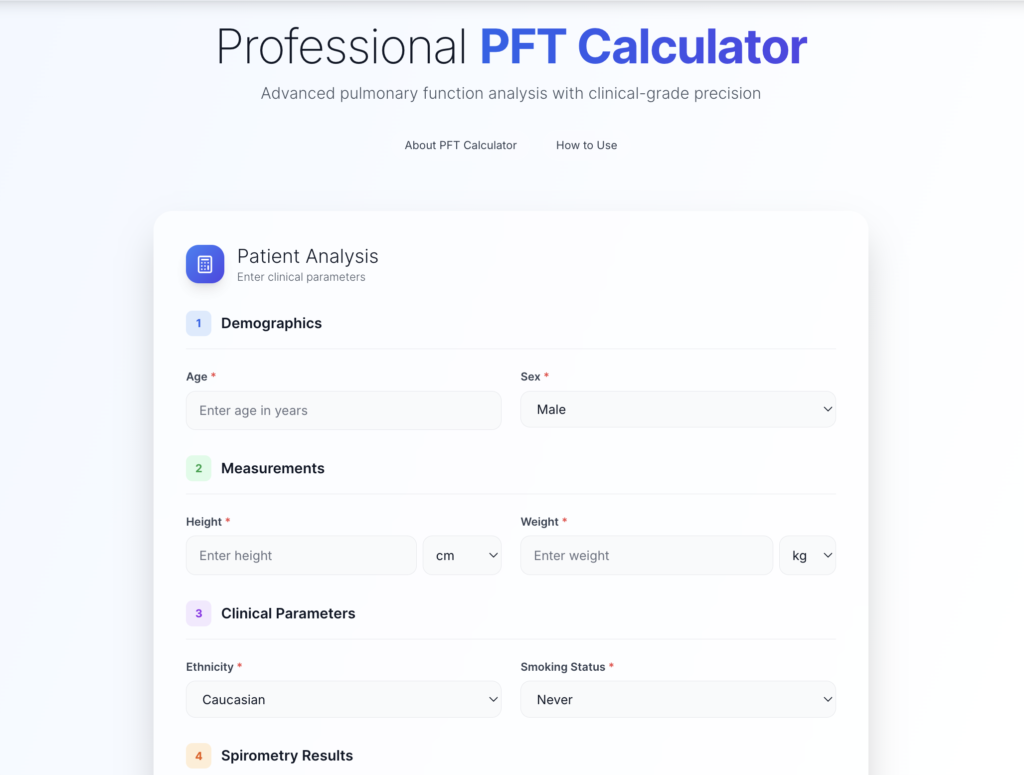
Professional PFT calculators address these challenges by automating the interpretation process while maintaining clinical-grade accuracy. The PFT Calculator at implements GLI-2012 equations and follows ATS/ERS (American Thoracic Society/European Respiratory Society) guidelines, providing instant analysis of key spirometry parameters including FEV1, FVC, FEV1/FVC ratio, and PEF.
These digital tools eliminate calculation errors and ensure consistent application of reference equations across diverse patient populations. By selecting the appropriate ethnic-specific corrections automatically, the calculator provides accurate predicted values whether evaluating Caucasian, African American, Asian, Hispanic, or other patient populations.
Clinical Applications in Daily Practice
For respiratory specialists and primary care physicians, access to a reliable PFT calculator streamlines workflow in multiple clinical scenarios. During initial diagnostic evaluation of patients presenting with dyspnea or suspected respiratory disease, the calculator provides immediate interpretation of spirometry results, allowing clinicians to make informed decisions about further testing or treatment initiation during the same visit.
In chronic disease management, serial PFT monitoring helps track disease progression and treatment response. A digital calculator makes it easy to compare current results with predicted values and identify clinically significant changes. This is particularly valuable for patients with COPD, where monitoring FEV1 decline guides therapeutic adjustments and prognosis discussions.
Pre-operative assessment represents another important application. Patients scheduled for thoracic surgery or other major procedures often require pulmonary function evaluation to assess surgical risk. Quick access to interpreted PFT results facilitates timely decision-making in surgical planning.
Understanding Z-Scores and Clinical Interpretation
Modern PFT interpretation extends beyond simple percent predicted values. Z-scores provide more precise clinical information by indicating how many standard deviations a patient’s result differs from the predicted mean. Results with Z-scores between negative 1.64 and positive 1.64 fall within the normal range, while values below negative 1.64 suggest abnormally low function.
This statistical approach improves sensitivity for detecting subtle abnormalities and provides better context for serial monitoring. A professional calculator that automatically generates Z-scores alongside percent predicted values gives clinicians comprehensive data for clinical decision-making.
Pattern Recognition and Severity Classification
Beyond calculating individual parameters, effective PFT interpretation requires recognizing ventilatory patterns. Obstructive patterns show reduced FEV1/FVC ratio, restrictive patterns demonstrate reduced FVC with preserved ratio, and mixed patterns combine features of both. A quality digital calculator identifies these patterns automatically and provides severity classifications based on current guidelines.
Severity grading helps standardize reporting and communication among healthcare teams. Knowing whether a patient has mild, moderate, or severe obstruction immediately contextualizes the clinical picture and guides treatment intensity decisions.
Integration into Clinical Workflow
The most effective PFT calculators integrate seamlessly into existing clinical workflows without adding complexity. Browser-based tools that require no installation or account creation offer maximum accessibility. Clinicians can access the calculator from any device in the clinic, hospital, or while reviewing results remotely.
Support for both metric and imperial units accommodates different practice settings and allows smooth transition for clinicians working across multiple locations or countries. The ability to quickly switch between measurement systems without conversion calculations further streamlines the interpretation process.
Ensuring Quality and Reliability
When selecting a PFT calculator for clinical use, healthcare professionals should verify that the tool follows current international guidelines and implements validated reference equations correctly. The calculator should be transparent about which equations it uses and regularly updated to reflect evolving clinical standards.
Professional-grade calculators like the one available at pft-calculator.com undergo validation by respiratory medicine specialists and maintain compliance with ATS/ERS standards. This level of clinical oversight ensures that automated interpretations meet the same quality standards as manual calculations by experienced pulmonologists.
Educational Value for Training Programs
Digital PFT calculators also serve an important educational role in respiratory medicine training. Medical students, residents, and respiratory therapy students benefit from interactive tools that demonstrate how patient factors influence predicted values. By manipulating inputs and observing how results change, trainees develop deeper understanding of pulmonary function physiology and interpretation principles.
The immediate feedback provided by calculators helps learners recognize normal ranges, understand ethnic corrections, and appreciate the clinical significance of different spirometry patterns. This hands-on learning complements traditional didactic teaching about pulmonary function testing.
The Future of Pulmonary Function Assessment
As healthcare continues embracing digital transformation, tools that enhance clinical efficiency while maintaining accuracy become increasingly valuable. PFT calculators represent one example of how technology supports better patient care by reducing administrative burden and allowing clinicians to focus on interpretation and treatment planning rather than mathematical calculations.
The widespread adoption of GLI-2012 equations through accessible digital tools promotes standardization in pulmonary function reporting globally. This consistency improves clinical communication and facilitates research by ensuring comparable results across institutions and countries.
Practical Implementation
Healthcare facilities looking to implement digital PFT interpretation tools should consider several factors. The calculator should be easily accessible to all clinical staff who interpret spirometry results, with minimal technical barriers to adoption. Training should emphasize that automated calculations support but don’t replace clinical judgment—results must always be interpreted within the context of patient history and clinical presentation.
Integration with electronic medical records, while not always necessary, can further streamline documentation when available. However, even standalone web-based calculators provide significant value by accelerating the interpretation process and reducing calculation errors.
Conclusion
Modern pulmonary function testing requires accurate interpretation based on current international standards and validated reference equations. Digital PFT calculators like the professional tool at pft-calculator.com make this sophisticated analysis accessible to healthcare providers across all clinical settings. By automating complex calculations while maintaining clinical-grade accuracy, these tools enhance diagnostic precision, improve workflow efficiency, and ultimately support better patient care in respiratory medicine.
Healthcare professionals seeking to optimize their spirometry interpretation process should explore how professional PFT calculators can integrate into their clinical practice. The combination of GLI-2012 equations, ATS/ERS guideline compliance, and user-friendly design creates a powerful resource for modern respiratory diagnostics.